

Variables
Every Request node has an optional Variable field. When you enter a name there, the user’s answer is stored under that name for the rest of the workflow run.How to name variables
- Use short, descriptive names without spaces (for example,
user_name,issue_type,order_number). - Variable names are case-sensitive.
- You can define as many variables as you need across different Request nodes.
How to use variables
Once saved, you can reference a variable in:- Message nodes — personalise text by inserting the variable (for example,
Thanks, {{vars.user_name}}! Let me look into that for you.). - Webhook nodes — include variable values in the request URL, headers, or payload sent to your external system.
- OpenAI Chat nodes — pass variable values into the node’s initial context.
- If / Else conditions — reference variable values in the condition expression to decide which branch to follow.
System variables
Alongside the variables you collect, every run carries a set of read-only system variables that describe the conversation context. Reference them with thesystem. prefix — the same way you reference vars., but you never set or change them.
System variables are available everywhere
vars are: Message node text, Webhook URL/headers/body, OpenAI Chat context, and If / Else conditions (as system.application_id, and so on).
Save variables from an OpenAI Chat node
The OpenAI Chat node can save values tovars directly — but only if you tell it to in the node’s Instructions. The node gives the model a built-in tool for storing workflow variables, and the model uses it whenever your instructions ask it to capture something.
Write the instruction in plain language naming the variable, for example:
vars immediately and persist for the rest of the run — exactly like a Request node’s answer. You can then reference them downstream with {{vars.product}} in a Message or Webhook, or branch on vars.order_number in an If / Else.
The
set_variable tool is available only on the OpenAI Chat node — it lets the model decide what to capture from the conversation. To save the node’s result instead, use the Output variable field described next (available on both the OpenAI Chat and AI response nodes).Save the node result with Output variable
Both the OpenAI Chat and AI response (RAG) nodes have an Output variable field. When you set it, the node’s completion result is saved to that variable, and you can read it downstream with{{vars.*}} or branch on it in an If / Else.
The stored value is the node’s full result object, so reference nested fields with dot notation:
- AI response (RAG) — when the knowledge base cannot answer, the result is
{ status: "unknown_answer", last_reply: "..." }. With Output variable set tokb_answer, you can use{{vars.kb_answer.last_reply}}or branch onvars.kb_answer.status == "unknown_answer". - OpenAI Chat — when the conversation reaches its Max Turns limit, the result is
{ status: "limit_reached", turns_used, last_reply: "..." }. With Output variable set toai_chat, you can use{{vars.ai_chat.last_reply}}.
Reference the output of the previous node
When a node’s result is not stored in a named variable, you can still react to it on the conditions of the edges leaving that node vialast_node.output. This is handy for branching on an AI response (RAG) or OpenAI Chat node’s result right after it runs, without setting an Output variable.
last_node.output is only available in If / Else and edge conditions (CEL) — not in {{...}} message or webhook templates. It always reflects the node that just completed and is overwritten by the next node, so branch on it immediately after the node.
AI response (RAG) node — when the knowledge base cannot answer (and a fallback is configured), the node completes with:
last_node.output lives only on the edges directly leaving the node and is overwritten by the next node, so you cannot reference it later in the flow or inside a {{...}} Message/Webhook template. If you need a value downstream, save it to a variable instead — with a Request node, a Webhook or agentic node Output variable, or an OpenAI Chat save instruction (see above) — and then read it as {{vars.*}}.Branching
Branching lets your workflow follow different paths based on what users have answered. There are two ways to branch.If / Else node
The If / Else node evaluates one or more conditions in sequence:- Add a Condition and give it a Label plus an Expression (CEL) — for example,
vars.issue_type == "billing". - Click Add Condition for each additional branch you need.
- Set a Default branch (else) as the path to follow when no condition matches.
== (equals), != (not equals), >, >=, <, and <= for numeric comparisons, && / || to combine checks, and string helpers such as .contains("...") and .matches("..."). Conditions can reference saved answers with the vars. prefix (for example, vars.order_number > 1000), run context with the system. prefix (for example, system.application_id), and the previous node’s result with last_node.output (for example, last_node.output.status == "unknown_answer" right after an AI response node).
Conditional connections on Request nodes
Single Choice and Smart Question nodes let you connect a specific path for each answer option (or detected intent). You can route users directly to the right next step based on their selection without an extra If / Else node. Multiple Choice nodes have a single onward path plus a fallback for invalid selections, so route their results with an If / Else node when you need to branch.Branch order matters
Conditions are evaluated top to bottom. Place your most specific conditions first and the default (Else) branch last.Testing
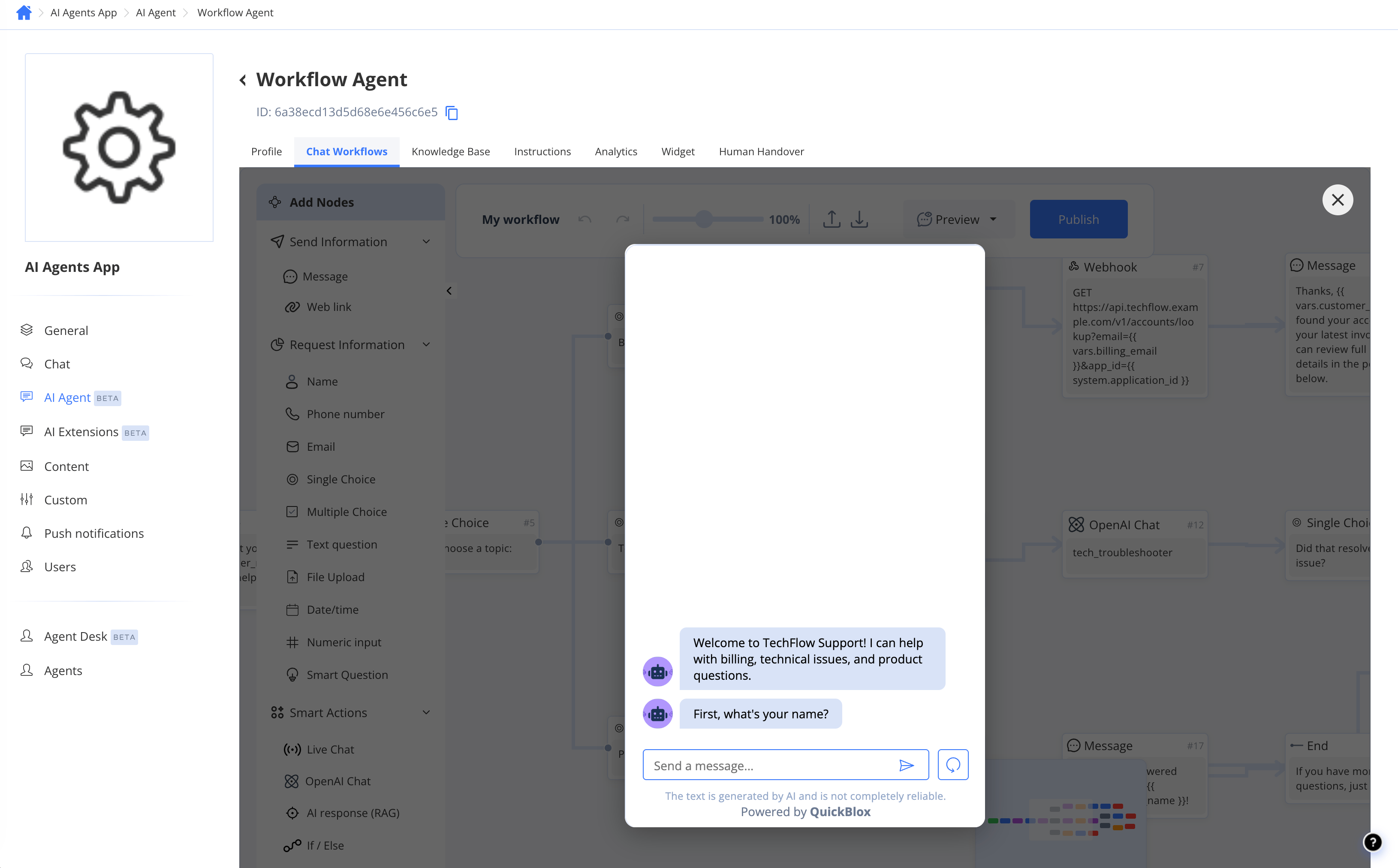
Widget Preview
The fastest way to test is the Preview button in the editor toolbar. It opens an embedded chat widget so you can walk through the flow as a user would — entering answers, triggering branches, and seeing messages — without affecting live users.AI Agent Tester
The AI Agent Tester is available from the agent’s main settings page. It runs the full agent logic, including the active workflow, in an isolated test environment. Use it to:- Test edge cases and uncommon paths.
- Verify that variables are saved and referenced correctly.
- Confirm that webhook calls are being triggered with the right data.
Live Chat handover is simulated in both Preview and the AI Agent Tester. The conversation will show a handover message, but no real human agent is notified during testing.
Best practices
Connect every path to an End node
Before publishing, confirm that every output port of every node leads somewhere — either to the next node or to an End node. Unconnected paths fail the publish validation check.Always set a webhook fallback
The Webhook node requires a fallback path. If the external server is unavailable or returns an error, the conversation follows the fallback path instead of stalling. Design the fallback to handle the situation gracefully — for example, an apology message followed by an End node or a Live Chat handover.Order branches from specific to general
In If / Else nodes, put the most specific conditions at the top and the broadest default (Else) at the bottom. This prevents a general condition from matching before a more specific one gets evaluated.Use descriptive variable names
Choose variable names that make your conditions readable (for example,subscription_type, not var1). This is especially helpful when collaborating with teammates or returning to a workflow after time away.